Monday, April 5, 2010

"The sacrificial system therefore presents different models or analogies to describe the effects of sin and the way of remedying them.
- The burnt offering uses a personal picture: of man the guilty sinner who deserves to die for his sin and of the animal dying in his place. God accepts the animal as a ransom for man.
- The sin offering uses a medical model: sin makes the world so dirty that God can no longer dwell there. The blood of the animal disinfects the sanctuary in order that God may continue to be present with his people.
- The reparation offering presents a commercial picture of sin. Sin is a debt which man incurs against God. The debt is paid through the offered animal."
"...They are human terms designed to give mere man some insight into the mysteries of our redemption."

- The New International Commentary on the Old Testament: The Book of Leviticus by George Wenham

Monday, March 29, 2010

perspective on Jersey Shore

(link)
"To Gaga, our video-game-playing, social-networking, cell-phone-obsessed culture has made all of us smaller, more normal, less interesting—and, except for odd lightning strikes like the Jersey Shore cast and Conan O’Brien’s anointment of one Twitter fan—famous to no one, after all. "

what a fascinating idea!! I had been wondering, in the back of my mind, why "Jersey Shore" had become the phenomenon it is today. If I understand what the author is saying, all of this communication and networking has exposed all of us as the same as the rest of us. We all watch the same shows and wear the same clothes and read the same blogs. We are globalized. However, when a show like "Jersey Shore" comes along, we have found a group that is truly different! They talk weird! They dress strangely! Their relational drama looks a little different! It's like finding a that group of Japanese soldiers that have been marooned on an island in the South Pacific and still think that WWII is going on. Our culture is fascinated by them.

Lady Gaga


New York Magazine: "How Lady Gaga Became the World's Biggest Pop Star"

"But [Madonna and Lady Gaga] are very different: Madonna hasn’t had a sense of humor about herself since the nineties, where Gaga is all fun and play. At her core, she’s a young art-school student, full of optimism and kindness, childlike wonder at the bubble world."

"But that’s the genius of Gaga: her willingness to be a mutant, a cartoon. She’s got an awesome sense of humor, beaming tiny surreal moments across the world for our pleasure every day—like the gigantic bow made of hair she popped on her head last year. “One day, I said to my creative team, ‘Gaultier did bows, let’s do it in a new way,’ ” she says. “We were going back and forth with ideas, and then I said”—snaps finger—“hair-bow.” She giggles. “We all f-ing died, we died. It never cost a penny, and it looked so brilliant. It’s just one of those things. I’m very arrogant about it.” Her videos are global epiphenomena, like the Tarantino-flavored “Telephone,” with its lesbian prison themes and Beyoncé guest appearance. “Gaga doesn’t care so much about the technical part, but she’s involved in every creative aspect,” says Åkerlund. “We just allow ourselves to be very stupid with each other, and then you get ideas like sunglasses made of cigarettes.”"

This is all so wonderfully postmodern. Postmodernism is exactly why Lady Gaga is a different type of pop-star than Madonna. With Madonna (as far as I can tell), people actually thought that she was creating something new. Lady Gaga knows that she will never be able to create something truly original.
This is the same boat that all postmodernists find themselves in. With the advent of the internet, we all know that there are no real new ideas. "Nothing is new under the sun." and all that.
So what's a postmodern pop-star to do? Make it a joke! Create visual jokes that make references and humorous juxtapositions. We can only create something new by taking pieces of old things and reforming them. And, the self-consciousness in this process ("I'm very arrogant about it" - about thinking that she could make something original...it was all Gaultier), being self-conscious about the process of stealing ideas...this is treated with humor. There is nothing worse than claiming originality and being proved wrong.

LOST title sequence, 60s style

Lost vs. Saul Bass from Hexagonall on Vimeo.


from Vulture

Sunday, March 28, 2010

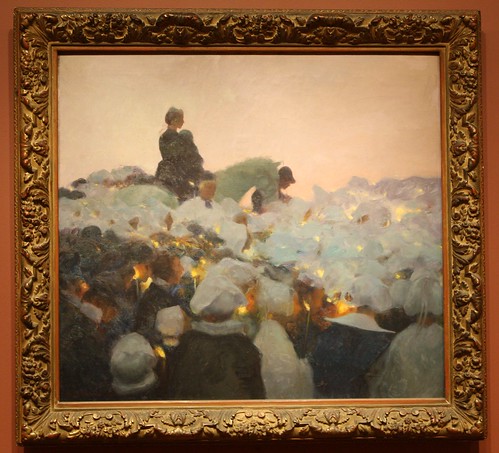
Gaston La Touche, "The Pardoning at Brittany"


since i can find NOTHING on this painting or artist, I will make it up. I think this was about some of the revival meetings in the 1700s in Britain, led by the Wesley brothers. Regardless, very pretty and meaningful. Seen at the Art Institute in Chicago.

OK, jk, I just looked it up and found out that Brittany is actually a region in northwest France. Hah, I'm silly!

*thanks for the correction on the name, cole!

Jules-Adolphe Breton, "The Song of the Lark"


Seen at the Art Institute in Chicago. I loved the mood of this painting. Also, I just found out on Breton's wiki site that Willa Cather's novel The Song of the Lark was named after this painting.

Hella Jongerius, "Embroidered Tablecloth, 2000"


Also at the Art Institute of Chicago. I thought this was particularly beautiful and interesting. I was talking with my sister-in-law over Thanksgiving about embroidery, as she uses it often in her art. She said that embroidery is meaningful to her because it cannot be reproduced. What a valuable thing in a world full of easy repetition.