Tuesday, June 26, 2012
Wednesday, June 6, 2012
Milan Men's Street Fashion
"I love how Milanese gentlemen move like they are the star of their own film.
Such swagger. Such intrigue.
This isn’t about fashion or even style but about creating an impact on the viewer.
A visual seduction."
- The Sartorialist (link)
Credit for all photos to the decidedly good-looking J. Willcox. Shot in and around the Piazza del Duomo and Galleria Vittorio Emanuele II, Milan.
Wednesday, May 9, 2012
Isambard Kingdom Brunel
Besides having an epic name, this architect from the mid-1800s made himself quite famous in London and beyond.
The first work of his that I saw in Ealing was the very large and impressive Wharncliffe Viaduct, which is still used today as a bridge for trains.
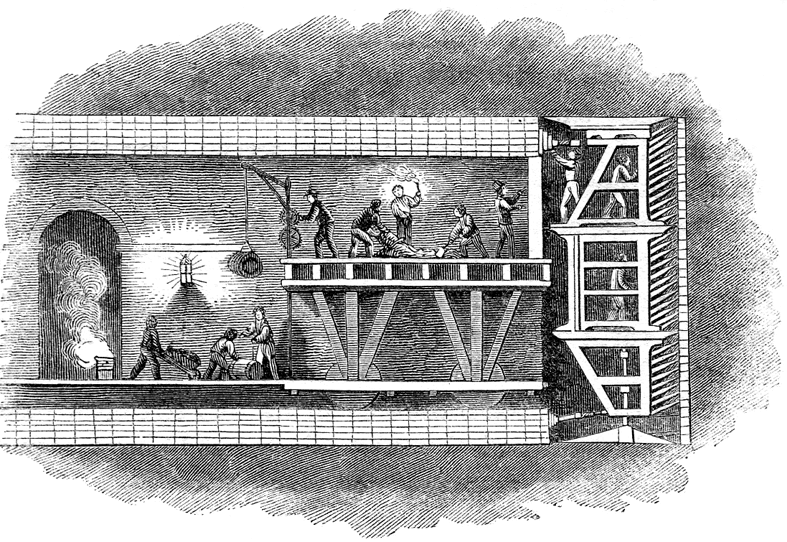
Brunel also worked under his Dad, Marc Isambard Brunel, in the beginning of his career and both worked on the Thames Tunnel which was, according to the Brunel Museum, the first tunnel under a navigable river. The tunnel now forms part of the London Overground train system. In 1828 there was an accident and the tunnel flooded, killing six men, and Brunel himself narrowly escaped drowning. He recuperated in Bristol, where he heard about the Clifton Suspension Bridge competition.
The Clifton Suspension Bridge in Bristol.
The Royal Albert Bridge between Plymouth and Saltash.
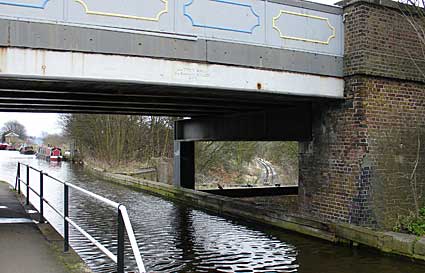
And finally, my favourite, the work of Brunel that is closest to my house: "Three Bridges" or "Windmill Bridge." It's incredible. The lower level is rail, the middle is the canal, and on top is Windmill Lane. Three levels!
I would love to now go and see the Brunel Museum in Southwark. Maybe I can drag some people to go with me?
The first work of his that I saw in Ealing was the very large and impressive Wharncliffe Viaduct, which is still used today as a bridge for trains.
| (source) |
Brunel also worked under his Dad, Marc Isambard Brunel, in the beginning of his career and both worked on the Thames Tunnel which was, according to the Brunel Museum, the first tunnel under a navigable river. The tunnel now forms part of the London Overground train system. In 1828 there was an accident and the tunnel flooded, killing six men, and Brunel himself narrowly escaped drowning. He recuperated in Bristol, where he heard about the Clifton Suspension Bridge competition.
| (source) |
| (source) |
| (source) |
| (source) |
Wednesday, April 18, 2012
Church History Walks in London
If none of these work out to be any good I will write my first book as an e-book on church history walks in London and sell it for £3-5.
Londontourist.org: 'City Churches Walk'
Friends of the City Churches - map of city churches (also features a church walk but the link is broken)
Spendtimeinlondon.com - free guided London walks - nothing here for church history walks but still seems quite useful for other interests.
I think I could do it! It would probably take a year to write a church history walking tour guide book for London but as long as I don't try to make a dissertation out of it and keep to the fact that my guide book will be more 'accessible' (positive turn on plebeian) than a church history professor writing it. Hmm...
Londontourist.org: 'City Churches Walk'
Friends of the City Churches - map of city churches (also features a church walk but the link is broken)
Spendtimeinlondon.com - free guided London walks - nothing here for church history walks but still seems quite useful for other interests.
I think I could do it! It would probably take a year to write a church history walking tour guide book for London but as long as I don't try to make a dissertation out of it and keep to the fact that my guide book will be more 'accessible' (positive turn on plebeian) than a church history professor writing it. Hmm...
Wednesday, April 4, 2012
Trying to understand "I, Pencil"
I'm in Jasper, Alberta, Canada right now on a school ski trip with a bunch of 12-16 year old boys. Two nights ago at the staff table we were discussing macroeconomics. This was in between announcements given to the boys and points were awarded for the staff member who could include hidden words ("menopause," "Albuquerque," "meow," "Munchausen syndrome").
After the discussion, one of the staff (economics teacher) told me to look up and read the essay I, Pencil by Leonard Read. It starts off by chronicling all the millions of people involved in making a single pencil - from the lumberjacks (are they still called that?) to the people who harvest the coffee beans for the lumberjacks' coffee - everyone. Read (in the voice of the pencil) states that no one of the millions involved in the manufacture of the pencil can make a pencil all by themselves. BUT (and here is the reason that S told me to read the essay) Read's position is that each person involved in the manufacture of the pencil is equal:
1. To produce a pencil, millions of people give their tiny bit of know-how.
2. However, these millions of people are not motivated by the larger purpose of producing a pencil but are instead motivated by receiving goods and services in exchange for his know-how (salary from the profit of the sale of the pencil, ultimately).
8. Okay, okay. On second thought, maybe it could work for the mail service to be privatised. After all, it does cost money and there is a possibility for profit, unlike the police and lighthouses. And it makes sense that if there is a profit to be had then people could organise to do it. I think that Read got my back up early on by saying that it was silly that only God could create a tree since we do not understand how one person could make a tree and then automatically assume that God is the only logical alternative. That is not why I believe that God makes trees.
I feel like I'm missing some key concepts here. I think I was distracted in the beginning by the God-tree comment. But, for what it's worth, I agree with the 'keep government small' deal. History has shown us plenty of examples of nationalised corporations being negative for the country's economy. However, I don't really latch on to the idea that privatising companies is a good idea because of my faith in humanity. I just think that the market keeps people more accountable than the government does. If a product does not sell then the market punishes the seller (in so many words). If a product does not sell and the government sells it then the process is a lot slower. Basically, the government is too big to fail and a healthy economy needs to allow companies to fail.
On the charities and government intervention thing...I don't know. It's dinner time.
After the discussion, one of the staff (economics teacher) told me to look up and read the essay I, Pencil by Leonard Read. It starts off by chronicling all the millions of people involved in making a single pencil - from the lumberjacks (are they still called that?) to the people who harvest the coffee beans for the lumberjacks' coffee - everyone. Read (in the voice of the pencil) states that no one of the millions involved in the manufacture of the pencil can make a pencil all by themselves. BUT (and here is the reason that S told me to read the essay) Read's position is that each person involved in the manufacture of the pencil is equal:
There isn't a single person in all these millions, including the president of the pencil company, who contributes more than a tiny, infinitesimal bit of know-how. From the standpoint of know-how the only difference between the miner of graphite in Ceylon and the logger in Oregon is in the type of know-how. Neither the miner nor the logger can be dispensed with, any more than can the chemist at the factory or the worker in the oil field—paraffin being a by-product of petroleum.OOooo and then he starts talking about The Invisible Hand! And then I get kind of lost in the essay. Okay, let's break this down:
1. To produce a pencil, millions of people give their tiny bit of know-how.
2. However, these millions of people are not motivated by the larger purpose of producing a pencil but are instead motivated by receiving goods and services in exchange for his know-how (salary from the profit of the sale of the pencil, ultimately).
Each of these millions sees that he can thus exchange his tiny know-how for the goods and services he needs or wants. I may or may not be among these items.3. There is no boss telling everyone to act in a certain way in order to produce a pencil, all of the people who work toward making a pencil work for their own goals and from their own motivations.
There is a fact still more astounding: the absence of a master mind, of anyone dictating or forcibly directing these countless actions which bring me into being. No trace of such a person can be found. Instead, we find the Invisible Hand at work.4. According to Read, since one person cannot make a tree that means that we must attribute it to God.
It has been said that "only God can make a tree." Why do we agree with this? Isn't it because we realize that we ourselves could not make one? Indeed, can we even describe a tree? We cannot, except in superficial terms. We can say, for instance, that a certain molecular configuration manifests itself as a tree. But what mind is there among men that could even record, let alone direct, the constant changes in molecules that transpire in the life span of a tree? Such a feat is utterly unthinkable!5. So, just as a person could not put together a tree, one person could not put together a pencil all by themselves. Therefore God makes pencils. This is silly, of course.
I, Pencil, am a complex combination of miracles: a tree, zinc, copper, graphite, and so on. But to these miracles which manifest themselves in Nature an even more extraordinary miracle has been added: the configuration of creative human energies—millions of tiny know-hows configurating naturally and spontaneously in response to human necessity and desire and in the absence of any human master-minding! Since only God can make a tree, I insist that only God could make me. Man can no more direct these millions of know-hows to bring me into being than he can put molecules together to create a tree.6. Read is proposing that people will naturally put themselves in order to create things. We must have faith in this aspect of humanity. Without government or any other mastermind figuring out things. Humanity will naturally fall into place producing things.
The above is what I meant when writing, "If you can become aware of the miraculousness which I symbolize, you can help save the freedom mankind is so unhappily losing." For, if one is aware that these know-hows will naturally, yes, automatically, arrange themselves into creative and productive patterns in response to human necessity and demand—that is, in the absence of governmental or any other coercive masterminding—then one will possess an absolutely essential ingredient for freedom: a faith in free people. Freedom is impossible without this faith.7. Ah-ha. I was all about to get ready to go on with how humanity is not inherently good from a Christian perspective and that faith in the goodness of humanity to produce everything that we all need is kind of short-sighted. But I see! This is an anti-state-run-companies essay, right? I still don't see quite how a bunch of people serving their own profit-centered interests could do a public service like delivering the mail. Doesn't that fall into the category of the police and lighthouses?
Once government has had a monopoly of a creative activity such, for instance, as the delivery of the mails, most individuals will believe that the mails could not be efficiently delivered by men acting freely. And here is the reason: Each one acknowledges that he himself doesn't know how to do all the things incident to mail delivery. He also recognizes that no other individual could do it. These assumptions are correct. No individual possesses enough know-how to perform a nation's mail delivery any more than any individual possesses enough know-how to make a pencil. Now, in the absence of faith in free people—in the unawareness that millions of tiny know-hows would naturally and miraculously form and cooperate to satisfy this necessity—the individual cannot help but reach the erroneous conclusion that mail can be delivered only by governmental "master-minding."
If I, Pencil, were the only item that could offer testimony on what men and women can accomplish when free to try, then those with little faith would have a fair case. However, there is testimony galore; it's all about us and on every hand. Mail delivery is exceedingly simple when compared, for instance, to the making of an automobile or a calculating machine or a grain combine or a milling machine or to tens of thousands of other things. Delivery? Why, in this area where men have been left free to try, they deliver the human voice around the world in less than one second; they deliver an event visually and in motion to any person's home when it is happening; they deliver 150 passengers from Seattle to Baltimore in less than four hours; they deliver gas from Texas to one's range or furnace in New York at unbelievably low rates and without subsidy; they deliver each four pounds of oil from the Persian Gulf to our Eastern Seaboard—halfway around the world—for less money than the government charges for delivering a one-ounce letter across the street!9. I agree with this as long as there is a profit to be made by the project. The government takes care of the rest because there is no profit to be had however all of society benefits from the government projects (lighthouses again). However, by saying that am I saying that the government should take over charities because there is no profit to be had?
The lesson I have to teach is this: Leave all creative energies uninhibited. Merely organize society to act in harmony with this lesson. Let society's legal apparatus remove all obstacles the best it can. Permit these creative know-hows freely to flow. Have faith that free men and women will respond to the Invisible Hand. This faith will be confirmed. I, Pencil, seemingly simple though I am, offer the miracle of my creation as testimony that this is a practical faith, as practical as the sun, the rain, a cedar tree, the good earth.Conclusion:
I feel like I'm missing some key concepts here. I think I was distracted in the beginning by the God-tree comment. But, for what it's worth, I agree with the 'keep government small' deal. History has shown us plenty of examples of nationalised corporations being negative for the country's economy. However, I don't really latch on to the idea that privatising companies is a good idea because of my faith in humanity. I just think that the market keeps people more accountable than the government does. If a product does not sell then the market punishes the seller (in so many words). If a product does not sell and the government sells it then the process is a lot slower. Basically, the government is too big to fail and a healthy economy needs to allow companies to fail.
On the charities and government intervention thing...I don't know. It's dinner time.
Monday, March 26, 2012
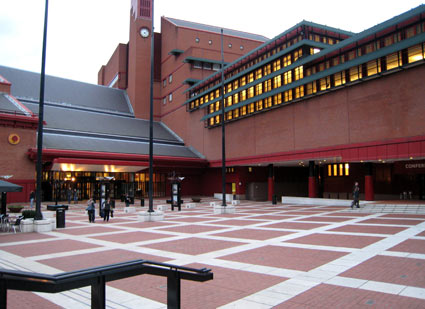
Visit to the British Library
The other day after finishing volunteering around Farringdon, I trotted down toward King's Cross Station because it was a beautiful day outside. As I walked along and got closer to King's Cross Station, I remembered that the British Library was quite close by. I also remembered (falsely) that it was a beautiful building. I think I might have been remembering St. Pancras (gorgeous) or something else nearby.
As I wandered around inside the British Library, I discovered that they have not one, but two copies of the Magna Carta! Incredible! I also found out that Leonardo Da Vinci wrote backwards. They have a few of his original journal pages there as well as original lyrics jotted down by the Beatles, among other treasures:
Also, I saw excerpts from a expedition newspaper from Sir Robert Scott's expedition to the South Pole in 1911. The plaque said that they saw evidence of climate change on that trip. I'm having difficulty finding anything more on this. Maybe I read it wrong.
I also saw these stamps, from Ibiza in 1936!
As I wandered around inside the British Library, I discovered that they have not one, but two copies of the Magna Carta! Incredible! I also found out that Leonardo Da Vinci wrote backwards. They have a few of his original journal pages there as well as original lyrics jotted down by the Beatles, among other treasures:
| The Burning of London in 1666 by Wenceslaus Hollar (source) |
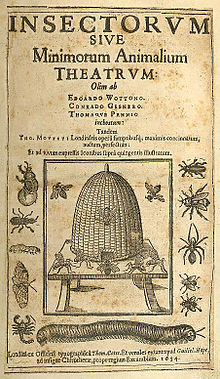
| Thomas Moffett's Insectorum Theatrum - 1590 (source) |
| From Florilegium Novum by Johann Theodor de Bry (1612) (source) |
| (source) |
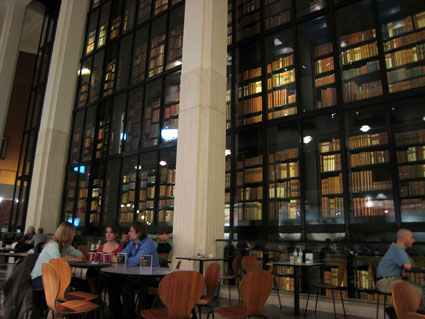
And lastly, I was struck by a very pinterestable thing, the center column of the library by the cafe:
| (source) |
Wednesday, March 21, 2012
Attachment 5 of 100
"I'm sure 'The Making and Breaking of Affectional Bonds' had a profound significance for my father. When he was young he was cared for by an affectionate and playful young nanny called Minnie, but she left the family when he was about four. He told me that he was very attached to Minnie and felt the pain of separation when their affectional bond was broken, but - although his work reminded him of this pain - he was able to work with it throughout his life. Losing a very important attachment figure and working out the importance of an enduring relationship was, I think, a large part of his motivation for a lifetime study of the affectional bond that forms between a child and his primary attachment figure." (Richard Bowlby's Introduction to The Making and Breaking of Affectional Bonds by John Bowlby (2004), xi)
I was talking to a guy who goes to my church this past Sunday who is a counsellor. He was mentioning his research for his Masters degree and was talking about how one of the things he was focussing on was why people go into the careers that they do. I've had a pet theory since college that people go into the field that they feel is the answer to the the most important problem in the world (for whatever reason). But what this counsellor was saying was that people who go into the helping professions (youth work and teaching, for example) are usually trying to heal some wound that they had received in childhood.
If the carer realises this about themselves and actively works through their own personal issue, then the work relationship between the carer and for whom they are caring can be fine and healthy. However, if the deep wound is not sorted out, the relationship can be selfish at its base, because the carer is seeking to heal themselves through the relationship and not actually do their job, which is to care well and unselfishly.
In some ways, I might have been on the right track with my theory in college. As human beings, we see our deepest wounds as the greatest problem in the world.
I was talking to a guy who goes to my church this past Sunday who is a counsellor. He was mentioning his research for his Masters degree and was talking about how one of the things he was focussing on was why people go into the careers that they do. I've had a pet theory since college that people go into the field that they feel is the answer to the the most important problem in the world (for whatever reason). But what this counsellor was saying was that people who go into the helping professions (youth work and teaching, for example) are usually trying to heal some wound that they had received in childhood.
If the carer realises this about themselves and actively works through their own personal issue, then the work relationship between the carer and for whom they are caring can be fine and healthy. However, if the deep wound is not sorted out, the relationship can be selfish at its base, because the carer is seeking to heal themselves through the relationship and not actually do their job, which is to care well and unselfishly.
In some ways, I might have been on the right track with my theory in college. As human beings, we see our deepest wounds as the greatest problem in the world.
Subscribe to:
Posts (Atom)