Sunday, February 27, 2011

To become an expert on...The Big Society

Many conversations I have had the last three weeks have mentioned The Big Society. Roughly defined (by wikipedia - here) it is "the flagship policy idea of the 2010 UK Conservative Party general election manifesto. It now forms part of the legislative programme of the Conservative – Liberal Democrat Coalition Agreement.[1] The aim is "to create a climate that empowers local people and communities, building a big society that will 'take power away from politicians and give it to people'."

I want to figure out what that means.
Wikipedia is just too easy to ignore. I'm going to go through their definition and try to figure out everything on there that confuses me. That should be a good starting point.

Okay, so here are some things that go into The Big Society:
1. There will be a Big Society Bank established in 2011 that will take money from banks, dormant British accounts (??), and charitable contributions. This money can be accessed by grants from charity organizations and community centers.
The Bank is a non-governmental organization. It will be financially self-sufficient. this is what it says (from the cabinent report):
"second, the Bank must help prove that putting
money into social ventures can generate both
social impact and real inancial returns. This is
vital for building market conidence in what is
a new ‘asset class’. It is also part of building the
Bank’s own investment track record, and thus
its ability to raise more capital if required"
What that sounds like is something like the microfunding projects like kiva.org and that other one by the Indian guy who only lends to women (i can't find the name of it now - GRAMA VASANTHAM' maybe?  Gramin bank!) where they claim that social entrepreneuership lending is actually profitable. but this is different. how can non-profits be profitable? am i missing something? moving on...

ok, ok...The Big Society Bank will not directly accept grants from non-profits. Rather it will give money to funds (intermediaries) that will give money to "social ventures." okay, i'm with you so far. i think the part that is confusing is that i'm not familiar with anything like this happening anywhere else. i need a podcast on this.

The New Yorker wrote a piece on this (Lauren Collins: "What's the Big Society?") and referenced Edmund Burke who is viewed as the philosophical founder of modern conservatism in the UK. And the New Yorker associated him with ideas such as government being left out of people's affairs and instead small bands of citizens joining together to accomplish things in society. I am out of my depth here.

"Communitarian Conservatism?"

An idea that might be scary to Brits but is normal to Americans is the existence of a big philanthropic sector. Americans don't assume that the government should be the first to help out homeless people. They assume that the shelters should. Why do we assume this? The Big Society is encouraging people to start taking responsibility for helping each other out instead of the government helping out. Wow. how does one change the social assumptions of a nation?? Wow.

The Labour Party has called this plan "DIY Britain" - haha.

Saturday, February 26, 2011

"Armed with such parallels, the Ever Wasers smile condescendingly at the Better-Nevers and say, “Of course, some new machine is always ruining everything. We’ve all been here before.” But the Better-Nevers can say, in return, “What if the Internet is actually doing it?” The hypochondriac frets about this bump or that suspicious freckle and we laugh—but sooner or later one small bump, one jagged-edge freckle, will be the thing for certain. Worlds really do decline. “Oh, they always say that about the barbarians, but every generation has its barbarians, and every generation assimilates them,” one Roman reassured another when the Vandals were at the gates, and next thing you knew there wasn’t a hot bath or a good book for another thousand years."
- "How the Internet Gets Inside Us" by Adam Gopnik
Read more http://www.newyorker.com/arts/critics/atlarge/2011/02/14/110214crat_atlarge_gopnik#ixzz1F4nJPE3x
"the real damage is being done at the neurological level, that our children are having their brains altered by too much instant messaging and the like. This sounds impressive but turns out to be redundant. Of course the changes are in their brains; where else would they be? It’s the equivalent of saying that playing football doesn’t just affect a kid’s fitness; it changes the muscle tone that creates his ability to throw and catch footballs."
"How the Internet gets Inside Us" by Adam Gopnik
Read more http://www.newyorker.com/arts/critics/atlarge/2011/02/14/110214crat_atlarge_gopnik#ixzz1F4khqLab
"Cognitive entanglement, after all, is the rule of life. My memories and my wife’s intermingle. When I can’t recall a name or a date, I don’t look it up; I just ask her. Our machines, in this way, become our substitute spouses and plug-in companions. Jerry Seinfeld said that the public library was everyone’s pathetic friend, giving up its books at a casual request and asking you only to please return them in a month or so. Google is really the world’s Thurber wife: smiling patiently and smugly as she explains what the difference is between eulogy and elegy and what the best route is to that little diner outside Hackensack. The new age is one in which we have a know-it-all spouse at our fingertips."

from "How the Internet Gets Inside Us" by Adam Gopnik
Read more http://www.newyorker.com/arts/critics/atlarge/2011/02/14/110214crat_atlarge_gopnik#ixzz1F4jkJL6y

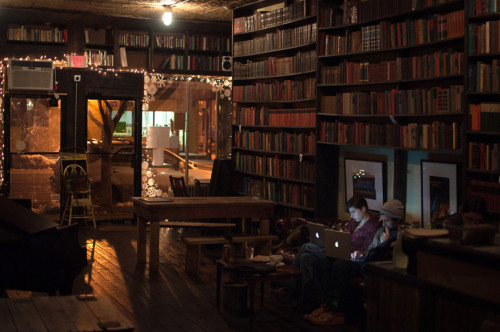
from (here) - Milk and Roses Cafe - Brooklyn, NY

London sewerage system


Place to visit next: London sewerage system.

Mainly because I've never heard anyone talk about it and it was on wikipedia's list of modern wonders of the world (here). and that's amazing.

Here's why it's cool:
- because it's beautiful
- was covered in the BBC mini-series Seven Wonders of the Industrial World (covering feats of engineering during the Industrial Revolution)
- "In the summer of 1858...London was in the grip of a crisis known as the 'Great Stink'. The population had grown rapidly during the first half of the 19th century, yet there had been no provision for sanitation."
- Parliament only authorized funds for the sanitation after "The Great Stink," defined: The Great Stink, or the Big Stink, was a time in the summer of 1858 during which the smell of untreated human waste was very strong in central London, England. (link). awesome.
- so, what happened was this: "Joseph Bazalgette, a civil engineer and Chief Engineer of the Metropolitan Board of Works, was given responsibility for the work. He designed an extensive underground sewerage system that diverted waste to theThames Estuary, downstream of the main centre of population. Six main interceptory sewers, totalling almost 100 miles (160 km) in length, were constructed, some incorporating stretches of London's 'lost' rivers." (also wiki)

These people know how to build a sewage treatment plant - it's so beautiful! Much better job than these guys: MSD-St. Louis.


this is my girl becky. it is a privilege to know her.